
Largest category28.6%Screen / display hardware
613 of 2,142 analyzable records5.0 from 17,000+ Google reviews Free diagnostics • 8 Florida stores • Many repairs same day
Check repair pricing5.0 from 17,000+ Google reviews Free diagnostics • 8 Florida stores • Many repairs same day
Check repair pricingWhat do repair records actually show about the laptop and computer problems that reach a professional repair bench?
PRM Repair Intelligence brings together original service-record research, customer symptom language and practical diagnostic guides from Phone Repair & More®. The goal is not to guess which devices “fail most.” It is to document what appears inside a selected real-world repair sample, explain what that evidence can and cannot tell us, and help you find the right next step for the problem in front of you.
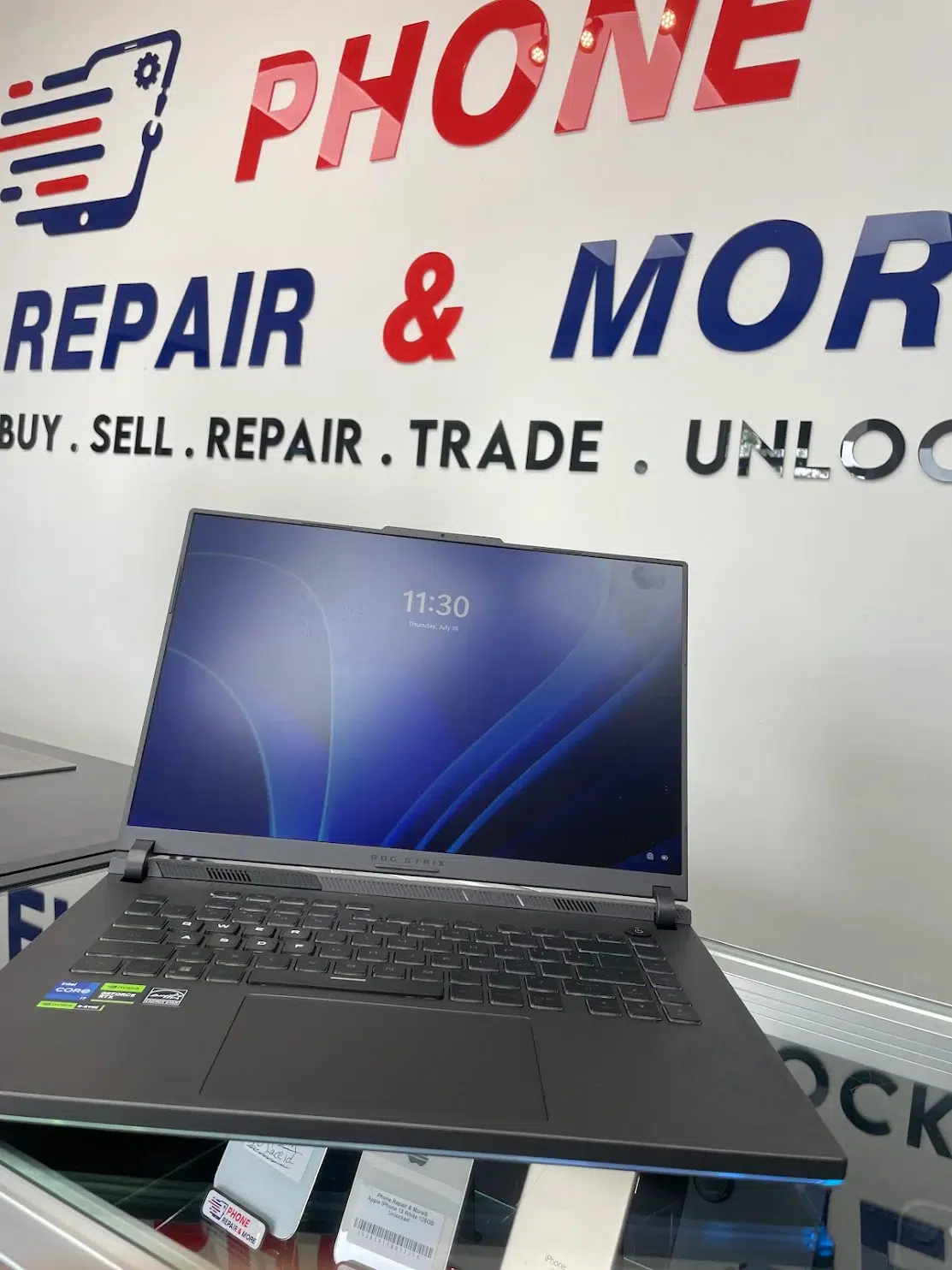
Laptop problems are easy to oversimplify.
A black screen does not automatically mean the screen itself failed. A laptop that will not charge does not automatically need a battery. A machine that freezes may involve software, storage, memory, power, thermal conditions or another hardware problem.
That is why PRM Repair Intelligence separates symptoms, recorded service categories and confirmed evidence instead of treating them as interchangeable.
These are operational service-category frequencies inside the frozen 2,142-record PRM sample—not product-wide laptop or computer failure rates.
“These figures describe the distribution of service categories within the selected Phone Repair & More repair-record sample. They are not product-wide failure rates, defect rates, reliability estimates, or probabilities that any laptop or computer model will experience a given problem. The sample consists only of devices that entered PRM’s service workflow and may reflect PRM’s locations, customer mix, services offered, record-keeping practices, and the period analyzed.”
“Percentages use the stated PRM sample denominator only and should not be generalized to the installed population of laptops or computers.”
Research Reports examine defined PRM datasets, disclose denominators and methodology, and separate what the records establish from what they cannot establish.
The broad view of the selected PRM operational sample, including service-category distribution, methodology, device classification, exclusions and limitations.
A closer look at screen/display evidence across the laptop-family dataset, with subgroup treatment constrained by the frozen small-sample rules.
A dedicated analysis of the MacBook evidence inside the selected operational sample, without turning service-record frequency into wider MacBook reliability claims.
You do not need to know the failed component before you begin. Each guide separates safe observations, possible explanations, PRM evidence where applicable, and professional-repair guidance.
No lights, no fan activity, intermittent power or a laptop that appears completely dead.
Read guide →The computer may appear to power on, but nothing usable appears on the display.
Read guide →The charger is connected, but the battery does not charge normally or the laptop only works under certain power conditions.
Read guide →Vertical lines, horizontal lines, flickering, color distortion or other display artifacts on a MacBook.
Read guide →Long startup times, delayed apps, poor responsiveness or a machine that feels much slower than it used to.
Read guide →The system becomes unresponsive, hangs during normal use or repeatedly requires a restart.
Read guide →Unexpected shutdowns can overlap with thermal, battery, power, software and other hardware symptoms.
Read guide →Short runtime, abnormal battery behavior, unexpected shutdowns or symptoms that may require separating the battery from the rest of the power chain.
Read guide →Spills and liquid exposure require a different diagnostic approach from ordinary software or hardware problems.
Read guide →Loose hinges, separating frames, damaged mounting points or chassis movement around the display.
Read guide →Individual keys, groups of keys, trackpad/input problems or broader keyboard failures.
Read guide →High temperatures, unusually aggressive fan behavior, thermal shutdowns or cooling-related symptoms.
Read guide →Storage problems, inaccessible files, failed drives and situations where preserving the data may matter more than restoring the computer itself.
Read guide →PRM uses two different internal evidence sources for two different questions—and does not convert one into the other.
These records help answer what service or repair categories were recorded after a device entered PRM's operational workflow.
2,142 analyzable completed records form the principal statistical evidence base for this collection.
These records help answer how customers described or selected the problem before diagnosis.
A lower evidence level is not automatically “bad” evidence. It answers a different kind of question. The important rule is not to present one evidence type as another.
Confirmed internal service data used for proprietary operational-category analysis.
What customers selected or described before diagnosis.
Reviews and customer statements used as reported experiences, not confirmed technical diagnoses.
Manufacturer documentation, support material and other primary technical information.
Credible external research and technical sources used when they materially improve context.
PRM includes computers only when the source data supports their classification. Generic “PC” or manufacturer labels are not silently converted into unsupported form factors or operating systems.
The operational export does not contain a universal operating-system field. The research therefore uses PC laptop unless an operating-system designation is directly supported by the source evidence.
The frozen Laptop & Computer dataset uses deterministic inclusion, completion and category rules rather than impressionistic sorting.
Device wording, approved families and conservative cross-category rules produce the 3,593-record candidate denominator.
Only records whose normalized status equals “invoiced” enter the completed-service denominator: 3,085 records.
Diagnostic-only, explicit warranty/rework, administrative/non-repair and unusable problem labels are removed from operational-category analysis.
Every analyzable record receives one mutually exclusive primary category for percentage calculations. Secondary tags remain separate multi-label metadata.
The permanent unique repair-record key combines normalized PRM Sub-Domain + Ticket #. Ticket # alone is not treated as globally unique.
Repair-shop data has a built-in selection effect: the devices in the sample are devices that reached a repair business.
That makes the data useful for understanding PRM's observed service mix, operational categories, symptom language and the kinds of problems that enter a real service workflow. It does not make the data a consumer-electronics reliability survey.
PRM Repair Intelligence is a national informational resource. Commercial service and local store intent remain on Phone Repair & More® service and location pages.
For supported MacBook, PC-laptop, Chromebook, Surface and other laptop repair needs.
View Laptop Repair →For desktop computers, all-in-ones and broader computer-service needs.
View Computer Repair →For cracked, damaged or professionally diagnosed laptop display repairs.
View Screen Repair →For battery replacement after the power problem has been properly evaluated.
View Battery Service →For city-specific repair information, store details and local service intent, use PRM's existing location pages rather than this national research collection.
Direct answers about the sample, evidence boundaries and how to use this collection.
PRM Repair Intelligence is Phone Repair & More®'s original repair-research program. It combines selected internal operational data, separately labeled customer symptom reports, primary technical sources and carefully qualified external evidence to create research reports and diagnostic guides about electronics repair.
The frozen Laptop & Computer research dataset contains 3,593 qualifying candidate records. Of those, 3,085 were completed/invoiced service records, and 2,142 met the frozen rules for Level A operational-category analysis. The analyzed sample is a selected research dataset and should not be presented as Phone Repair & More®'s complete historical repair volume.
No. They describe the distribution of operational service categories within the stated selected PRM sample. They are not product-wide defect rates, reliability estimates or predictions about what will happen to an individual laptop or computer.
An appointment tells us what a customer selected or described before diagnosis. A repair record documents PRM's operational service workflow. Because these exports do not contain a validated booking-to-repair join key, PRM does not convert appointment symptoms into confirmed diagnoses.
The repair export does not contain a universal operating-system field. The default research category is therefore PC laptop unless the operating system is directly supported by the source evidence.
A laptop that will not turn on can involve different stages of the power and startup process. Start with the Laptop Won't Turn On Diagnostic Guide.
A black screen can occur even when the computer appears to power on, so it should not automatically be treated as the same problem as a completely dead computer. Start with the Computer Black Screen Diagnostic Guide.
Use Phone Repair & More®'s Laptop Repair or Computer Repair service pages for professional repair information, then choose the appropriate PRM location for local store details.
Selected operational repair data. Real customer symptom language. Transparent methodology. Clear limitations.